
How I Healed My Body from the Inside Out: A Journey Through Trauma, EFT, and Somatic Awareness
One woman’s path from chronic stress and childhood trauma to inner peace—and the surprising physical changes that followed. Based on the video I Released 30+ Years of Trauma Trapped in My Body – Here’s How.
What if the tension stored in your body from decades of unprocessed trauma was quietly shaping your health, your posture, and even the structure of your bones—and you had no idea?
That’s what I discovered in my 40s, after a minor conflict with two other mothers sent my mind into a three-day spiral I couldn’t escape. It was the crack in the wall that revealed something I’d been carrying my whole life: the weight of grief, fear, humiliation, and loss, all of it compressed into my tissues, my nervous system, my very bones.
What followed was years of deliberate inner work—through EFT tapping, somatic awareness, and learning to place my conscious attention inside my body. I grew three-quarters of an inch in my 50s. My skull bones shifted. The voice in my head that said “I hate myself” went permanently silent. This is the story of how that happened, and how you can begin the same journey.
When the Mind Won’t Stop Spinning
The moment that cracked everything open wasn’t dramatic by most standards. Two self-assured mothers at my sons’ school told me I’d done something wrong, and my mind locked onto it like a vice. For three days, I replayed every word, every moment, every possible alternative. I couldn’t stop it.
After three days, I recognized two things clearly: this reaction wasn’t proportionate, and it felt exactly like how I’d responded as a child when my father told me I’d done something wrong.
That small recognition—that my past might still be running the show—was enough to set me on a path I’ve never stepped off.
My childhood had given me plenty to work with. A house fire. A boys’ boarding school where I was relentlessly teased. Parents who became alcoholics during my teenage years. And at 19, finding my mother dead on the bathroom floor. I’d moved from England to the United States at 21, half-believing I could leave it all behind. We can’t. We take ourselves with us.
Discovering EFT: The First Release
In my early 40s, a holistic physician asked me on a scale of zero to ten how stressed I was. I said eight. When he asked why, I surprised myself: I started crying about my mother’s death—more than two decades after it happened. The tears were still right there, just under the surface, waiting.
He introduced me to EFT, or Emotional Freedom Technique—sometimes called tapping. It involves tapping on specific points on the body while speaking through a memory or emotion. We worked together for about fifteen minutes. I said things out loud I hadn’t said in years. I let the tears come. And by the end of the appointment, I could think about finding my mother without the tears returning. The charge was gone.
That was the moment I understood, for the first time, that we hold emotional memories physically in the body—and that we can release them.
Building a Daily Practice
I went home and learned everything I could about EFT. Gary Craig, who developed the modern form of the technique, had made his foundational teachings freely available online, which made it accessible without financial investment.
To test it properly, I chose something personal and concrete: I was terrified of giving my 17-year-old cat his daily saline injections. My hand shook the first time. I wasn’t sure I could keep doing it. So I tapped—on my fear of needles, on my fear of hurting my cat, on every injection I’d ever received over my lifetime. The next day, my hand was steady. The fear was simply gone.
That’s when I committed fully.
I started asking myself throughout the day: How am I feeling right now? Do I want to keep attracting this into my life? If the answer was no, I tapped. I’d bring myself back to peace before moving on. Over weeks, I became harder to trigger. My nervous system quieted. My family around me became calmer too—because I was no longer reacting, and they no longer had to react to my reactions.
Going Deeper: Working Through the Archive
Once I understood that tapping worked, I got systematic. I wrote down every significant emotional memory I could access—traumas, humiliations, moments of shame or anger, resentments, things I’d never let go of. Multiple pages.
Each night, I’d go to a quiet room and tap for an hour to an hour and a half on a single item from that list. I’d work through it until the emotional charge released, check back the following day, and if it was clear, move to the next one.
As I worked through the list, something unexpected happened: my mind began to quiet in ways I couldn’t have imagined. The critical, self-attacking thoughts that had felt like background noise my whole life began to disappear. It was only once they were gone that I recognized what they actually were—my father’s words, internalized so early and so completely that I’d mistaken them for my own voice.
I even tapped on the belief “I hate myself,” spending multiple hours over several weeks focusing on that phrase until it became just three words with no emotional weight behind them. That thought has never returned.
An important note here: people often say not to focus on the negative. This work is the opposite of that advice—and for good reason. The stored pain is in the body. You have to bring your attention to it to release it. Avoidance doesn’t clear it. Contact does.
From Tapping to Feeling: Learning to Sense the Body
EFT opened a door. What came next took me further inside.
Through studying with a group and continuing my own inner work, I began to understand what it actually meant to feel your feelings—not name them, but actually sense the physical sensations underneath the labels. Words like “frustration” or “fear” are shorthand we learn in childhood. The actual sensations sink into the subconscious. Most of us lose contact with them entirely.
Frustration, for me, lives around the solar plexus and rib cage, with tension spreading into the shoulders and jaw. Fear settles in the solar plexus too, but differently. Once I could sense these textures, I began to work with them directly.
I’d identify a thought with an emotional charge—something like a fear of making a difficult phone call—and then hold my attention on the sensation itself. Not the story. Not the word. The raw physical feeling. I’d hold myself still, no breathing, and simply allow the sensation to be felt. I’d speak to it quietly: I can feel you. It’s okay to be felt.
When I’d have to breathe or shift, I’d think the thought again and notice whether the sensation had diminished. Usually it had. I’d find it again and hold it again. Slowly, with repetition, these long-held tensions would release.
It wasn’t fast. But it worked.
Placing Awareness Inside the Body
After an extended period of massive energy that I recognized as Kundalini—which lasted several months and felt like a burning through of deep layers of stuck tension—something shifted in how I could relate to my own body.
I discovered I could place my awareness inside my body and keep it there. Not visualize it from outside—actually sense from within. Moving through regions of tissue and bone, noticing where things felt dense or blocked, where there was tension versus ease.
I eventually worked out that I seem to sense from a fixed point inside my skull—somewhere behind my nose and below my eyes, closer to what I believe may be the body of the sphenoid bone. From this point, I could direct my attention inward like a laser beam, find a knot of tension, and hold my focus there until a release occurred.
Bone feels denser than soft tissue. I can distinguish them. I can’t tell the difference between individual organs, but I can feel where something is stuck.
Once I understood I was sensing from one place inside my body and attending to another, something philosophically significant clicked: I’m not my body. I inhabit it. That phrase—”you are not your body”—had floated past me in spiritual circles for years without landing. This time, I knew it firsthand.
The Physical Changes: Bones, Posture, and Height
Over time, this inner focus work began producing measurable changes.
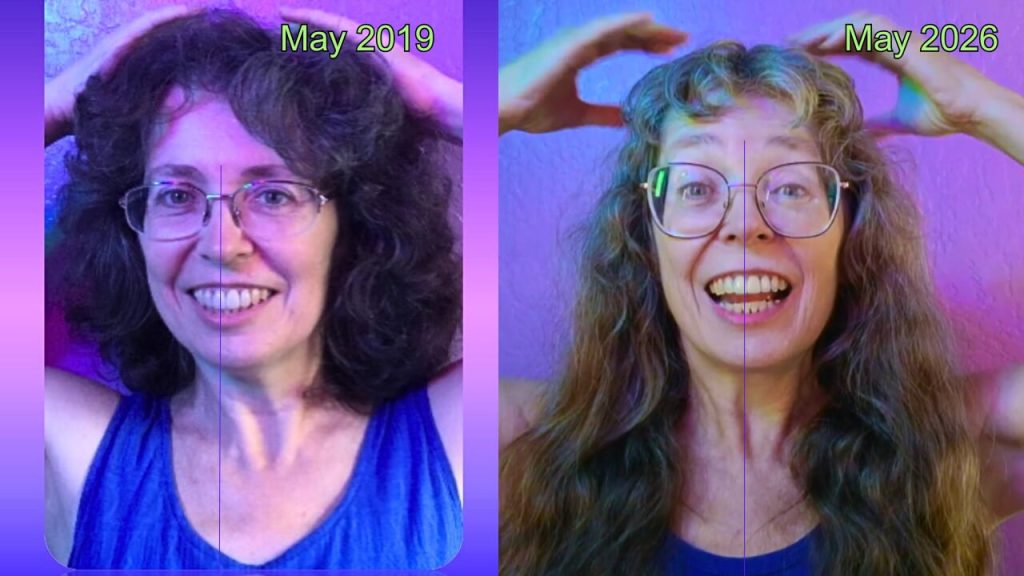
The most striking: I grew three-quarters of an inch in my 50s. I’ve also had new orthodontic X-rays taken that I can compare to older ones. My skull bones have moved. My eye sockets have aligned differently than before. My neck—which carries a scoliosis connected to a foot deformity I was born with—is gradually straightening.
One of the most intense areas of tension I found was inside my left cheek. I had no conscious awareness this pain existed before I began this work. Once I could feel it, it was almost unbearable. I could only hold attention on it for a second at a time to begin with. Over months of focused attention, adhesions in the connective tissue began releasing. Once, I actually heard something release—like old fabric tearing. It startled me. Afterward, I learned it was almost certainly an adhesion in the fascia letting go.
My body now cracks and releases tension spontaneously throughout the day—sometimes fifty to a hundred times daily—simply as a result of where I place my attention. I don’t force it. I find the tension and hold my awareness on it. My body does the rest.
My face is still asymmetrical. My neck is still not fully straight. This isn’t a finished story. But the direction is clear, and the evidence is in my body and on my X-rays.
What This Work Is Really About
None of this started with the goal of changing my bones. It started because I couldn’t stop my mind from spinning over a minor social conflict, and I was scared of nine-year-old boys.
The physical changes are real and they matter. But the inner changes are what made everything else possible: the quiet mind, the absence of self-attack, the capacity to stay steady when things around me are difficult, the ability to be present for my children in ways I couldn’t have managed before.
Every layer of emotional release opened a deeper level of physical awareness. Every physical release opened a deeper level of peace. They aren’t separate processes. They’re the same one.
The tension in the body isn’t just physical. It’s the past, compressed into tissue. And the body knows how to release it, once you give it your attention.
Key Takeaways
The body stores emotional memories physically. Trauma, grief, fear, and shame don’t disappear when we stop thinking about them—they compress into the nervous system, connective tissue, and bones.
EFT tapping is a concrete entry point. By combining focused attention on a memory with physical tapping, stored emotional charges can be identified and released. The results are measurable and often immediate.
Somatic awareness deepens over time. As emotional layers clear, physical sensation becomes more accessible. You can learn to place your attention inside your body and directly release tension held in tissue and bone.
The negative must be faced, not avoided. Healing requires bringing focused attention to what’s painful—not to dwell in it, but to allow it to be felt and released.
Physical change follows inner work. Posture, symmetry, bone structure, and height can change as long-held tension is cleared. The body is more dynamic than we’ve been taught to believe.
“The tension in the body isn’t just physical. It’s the past, compressed into tissue—and the body knows how to release it, once you give it your attention.”
Where to Start
If any of this resonates, the place to begin is simple: notice how you feel right now, in your body. Not the word for it—the actual sensation. Where is it? What does it feel like? Can you stay with it without moving away?
That moment of contact is where healing begins.
EFT is freely available and widely taught – I have a video called EFT 101: How To Do EFT Tapping (Beginners Guide). Start there if you need a structure. Then, as your self-awareness deepens, you may find yourself moving toward the subtler somatic work described here—sensing inward, releasing tension at the level of tissue and bone.
This isn’t a quick path. But it’s real, it’s available to anyone willing to do it, and the results accumulate in ways that are genuinely life-changing.